
Search Worth County Property Records
Start with the Worth Board of Tax Assessors qPublic page. There an address, an owner name, or a tax-map number will identify the assessment parcel. Copy down the situs address, owner field, map number, legal description, acreage, and tax year. The county calls this its most current published tax digest, and that wording matters. The digest is an assessment snapshot. It cannot promise the owner field reflects a deed recorded yesterday.
Next, tie the parcel to the GSCCCA real-estate index. Then check the Worth County Clerk of Superior Court. The newest deed names the grantee, the party receiving the interest. A plat adds recorded lot and boundary context. The Tax Commissioner supplies the current tax bill. City permit and zoning files describe land use. They do not prove title.
- Find the parcel in Worth qPublic by address, owner, or map number.
- Match its legal description to the latest Clerk or GSCCCA deed.
- Read the Tax Commissioner statement for the bill and payment status.
- Compare qPublic geometry with the recorded plat.
- Request an existing city permit, zoning file, or certified instrument when needed.
Worth County Records Offices
Three offices at the Worth County courthouse divide the work. The Clerk of Superior Court records deeds, security deeds, assignments, easements, rights-of-way, plats, liens, and fi fas. The Board of Tax Assessors values parcels and publishes the digest through qPublic. The Tax Commissioner bills and collects the tax, but sets neither value nor millage. All three sit at 201 N Main Street in Sylvester. Each, however, keeps its own distinct record set and request process.
Worth County Clerk of Superior Court
201 N Main Street, Room 30
Sylvester, GA 31791
(229) 776-8200
Worth County Tax Commissioner
201 N Main Street, Room 15
Sylvester, GA 31791
(229) 776-8204
Worth Deed Search Paths
GSCCCA offers separate Real Estate, PT-61, Lien, Plat, and UCC search modes. The right one depends on the question. For a deed, search grantor and grantee names. Then pull the image by book and page or instrument reference. A plat search works from its name or book and page. PT-61 adds transfer context, but it is not the deed itself. Some images and advanced tools require an account or payment.
The local alternative is the Clerk. Requests work best with the instrument type, the parties, an approximate recording date. Include book and page or instrument number, legal description, and parcel address. The county also links eCertification. It walks a request through county and document-type selection, payment, and email delivery of an authenticated copy. GSCCCA publishes no earliest online year for the Worth deed index.
Worth Assessment Dates Matter
The assessor has announced a three-year countywide review, with GMass handling field work. A review may follow an ownership change, a permit, or a return. It may also follow a fire, demolition, or another property change. During the stated review period, staff may measure improvements, list construction, and take photographs. Marked vehicles, government plates, and identification distinguish the field team.
This is why a Worth County property-record search should always preserve the tax year and digest date. A new deed, a pending field review, or an appeal can all describe one parcel at different stages. A later tax bill can too. Do not flatten that sequence by calling every number current. The assessor landing page is the official gateway, and it states the published-digest limitation itself.
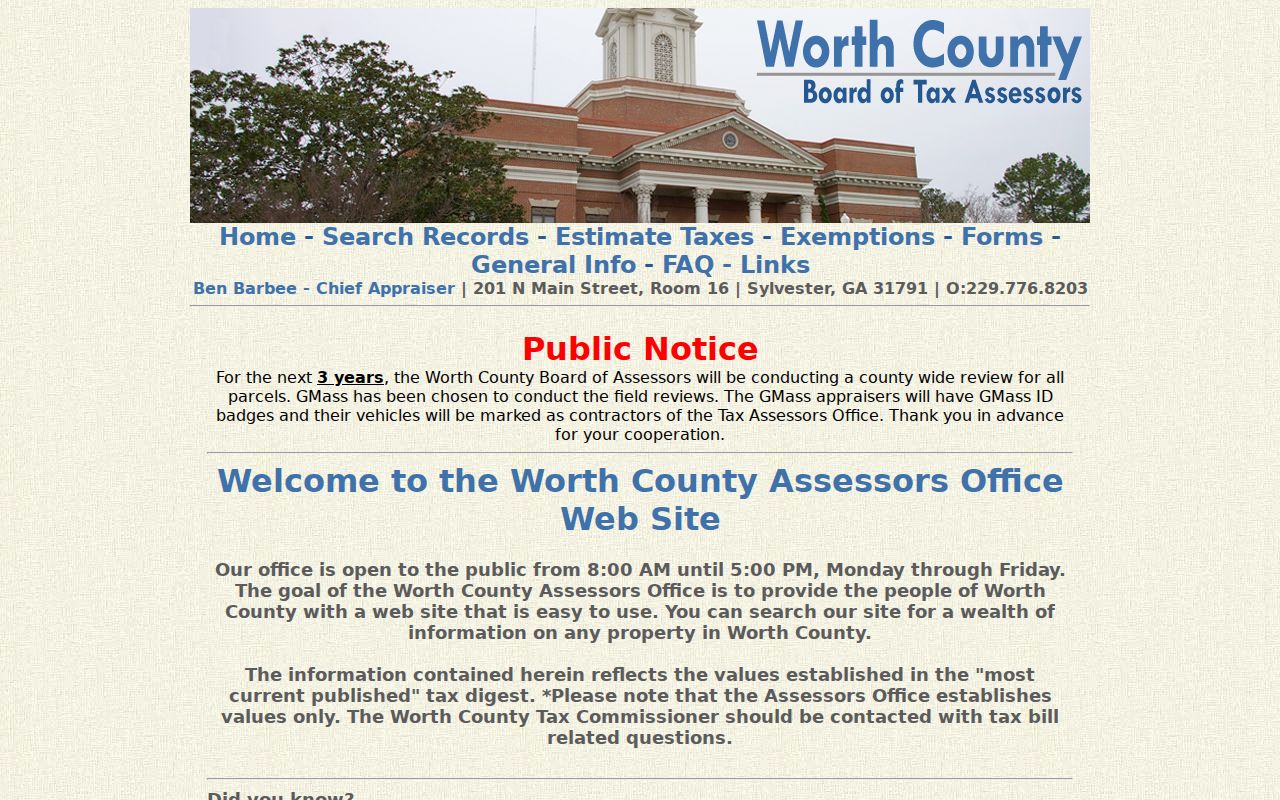
The official assessor page anchors the search to Worth County. It links to the parcel interface and the assessor's notices.
Worth County Property Record Types
One parcel can generate several record families. The recorded instrument establishes a conveyance or encumbrance. The assessment card carries the published owner field and value. A tax statement shows the amount billed, and the parcel map supplies geographic orientation. A recorded plat is different. It carries the lot, block, roads, easements, and dedication terms within its scope. City and county permit files address work or land use. They say nothing about ownership.
| Record Type | What It Documents | Kept By | Access |
|---|---|---|---|
| Deeds | Transfers and recorded parties | Superior Court Clerk | GSCCCA, eCertification, counter request |
| Security deeds and liens | Secured interests, assignments, releases, fi fas | Superior Court Clerk | GSCCCA or Clerk request |
| Assessment and tax | Published value, exemptions, bill, payment status | Assessors and Tax Commissioner | qPublic, tax site, phone, mail, counter |
| Plats and parcels | Lot, block, acreage, roads, and mapped shape | Clerk and Assessors | Plat index, qPublic, records request |
| Permits and zoning | Applications, inspections, approvals, and land-use files | City or county office | Published forms or direct request |
Match the source to the fact in dispute. Ownership calls for the deed chain. A value question starts with the dated assessment. A boundary question needs the plat and, when the line must be placed on the ground, a survey. Every source should answer its own question without being stretched into proof it cannot supply.
Worth Tax Records Split
Georgia assessment language can look like one calculation, but two Worth offices maintain it. The assessors establish fair market value as of January 1 and the local guidance states that assessed value is 40 percent of fair market value. Eligible exemptions reduce the net taxable assessment. Millage then converts that base into a bill. One mill is one dollar per one thousand dollars of assessed value.
The Tax Commissioner’s pages preserve a local timing conflict. General information says real-estate taxes are due by November 15, while the FAQ describes October 15 and November 15 installments. Check the current statement or office notice instead of merging those statements. The FAQ says statements are mailed by September 15, and the commissioner accepts mail, online and phone payment paths, plus a courthouse drop box.
Worth Parcel Number Clues
Legal notices in Worth County reveal several parcel number styles. Examples include SV070-00000-021-000, Tax Map 74 Parcel 19, 00600037, and Tax Map SV 8 Parcel 134. Keep the leading zeroes, hyphens, and spaces when you cite a result. Use stripped or respaced versions only as alternate search terms. What an SV prefix signifies remains unclear, and no official field dictionary defines it.
Remember that a parcel number is a tax and map key. It is not a legal description. Before treating two property records as the same tract, check the number carefully. Match it against the address, acreage, land lot and district, plat reference, and the deed's own description. A changed number may simply reflect reformatting. It could also mark a parcel split, a combination, reassessment, or a vendor migration.
Worth Maps Need Recorded Plats
For mapping, the county assessor links to a Schneidercorp qPublic parcel viewer. This is the closest public map Worth County offers. Treat the parcel geometry as an orientation aid. Note the map date or digest year whenever the viewer displays one. The county publishes no confirmed tool list, export options, or refresh schedule. Do not count on features that are not stated. A recorded plat gives you the legal lot drawing. The Clerk and the GSCCCA Plat Index are the right stops. A plat may lay out lots, blocks, roads, easements, and dedication terms. Georgia's annual GIS digest standards set the submission fields counties use. Those fields include parcel number, acres, digest class, tax district, and description. Those standards do not mean Worth offers a public GIS download. An Open Records Act request can ask for the county's existing GIS layer and metadata. It does so without staff building a custom map.
Worth City Record Boundaries
Sylvester, Poulan, and Warwick each hold municipal records that sit beside county property records. Sylvester's Community Development office covers planning, zoning, permits, inspections, licenses, and code enforcement. Poulan posts zoning and subdivision resources plus a business-license process with zoning verification. Warwick publishes no online permit or zoning database. City Hall is the direct route to an existing parcel file. A postal city is not a corporate boundary. ZIP labels like Sylvester 31791, Poulan 31781, and Warwick 31796 can reach addresses outside city limits. Confirm city status through an annexation ordinance, a boundary map, or a municipal response. County qPublic and Clerk records still identify the parcel. They also identify its recorded instruments no matter which city keeps the permit file.
Worth Records Before 1853
Worth County formed from Dooly and Irwin counties in 1853. A deed chain reaching earlier may continue in a parent county. It is not necessarily a missing Worth volume. The Georgia Archives holds a Worth County Records Microfilm Index card. Its research guidance points to the FamilySearch catalog under Georgia, Worth County, Land and Property. Some images must be browsed by book and page because they are not name searchable.
The courthouse burned in 1982. Treat that as a clue, not proof that a particular book vanished. Ask the Clerk whether a volume was recreated, relocated, or microfilmed. Newspapers can bridge the gaps. The Worth County Library archive holds local runs from 1885 through 2013. Georgia Historic Newspapers carries Worth issues through 2024. OCR finds leads. The page image and the recorded instrument supply verification.
Worth Filing Alerts Start Forward
Georgia's Filing Activity Notification System is known as FANS. It can alert a registered user when new filing activity appears under a monitored name. It looks forward only. It is not a title report and not a search of every past deed. Name variations still matter, especially for entities, trusts, estates, and people who share a name. The official FANS screen displays the account entry point.
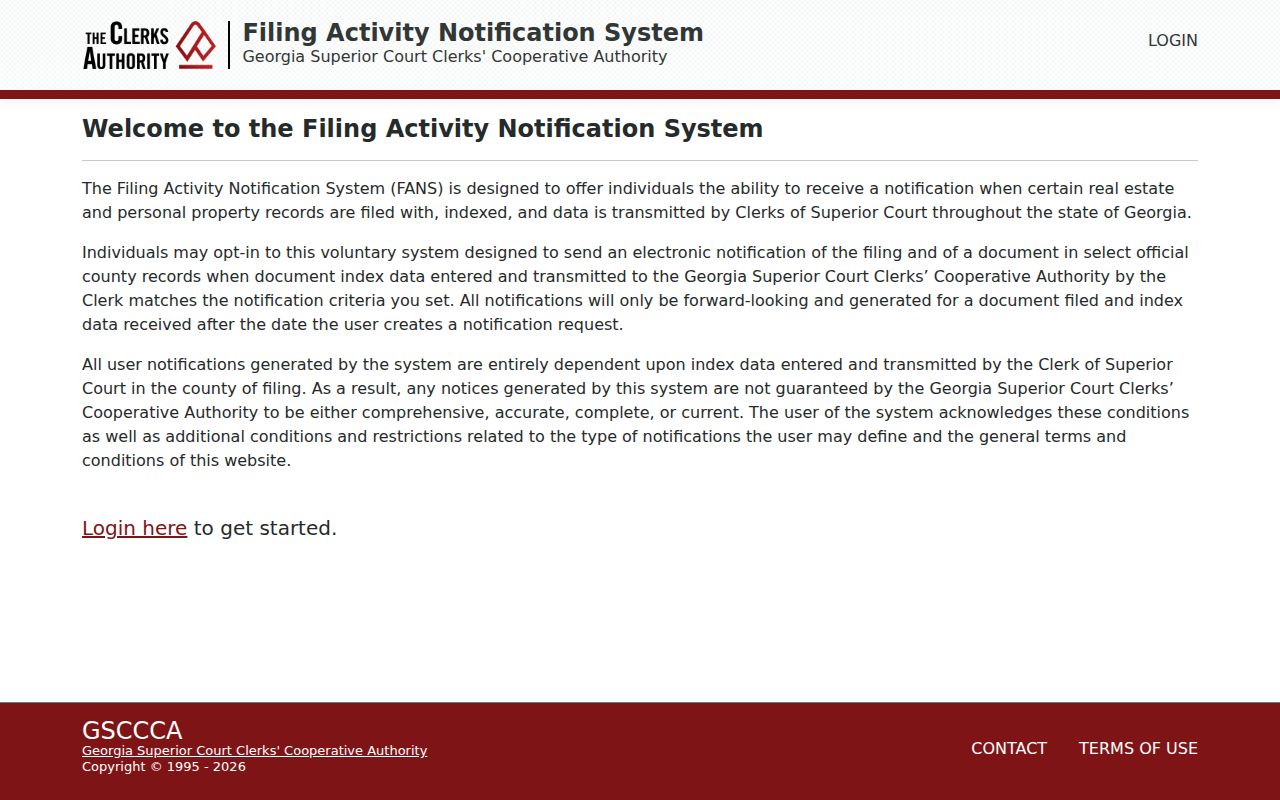
Filing alerts add a monitoring layer to a Worth County property-records routine. They still do not replace the Clerk's index, which remains the place to verify an instrument itself.
Georgia Records Requests for Worth
Georgia's Open Records Act generally requires an agency response within three business days. Records are not always produced at once. In that case, the agency should say what it holds. It should also estimate timing and cost, and cite the legal basis for anything withheld. State guidance permits reasonable charges for search, retrieval, copying, and staff time. The first quarter hour of staff time is free. A ten-cent paper copy appears as a state example. That figure is not a promised Worth County office price.
Ask for something that already exists. That could be a deed image, permit log, map, spreadsheet, ordinance, or metadata file. An agency generally need not create a new report for you. Give the parcel number, address, legal description, record type, date range, and the electronic format you want. For certified deeds and court records, the Clerk's eCertification route beats a broad request.
Worth Reassessment Timeline
The 2025 countywide reassessment changed how dates should be read in Worth County. County notices described reassessment and digest growth. Sylvester meeting material later discussed outstanding appeals and delayed bills. Those are separate events. The value date, appeal status, millage decision, statement date, and payment deadline should never be collapsed into one "current" label.
For comparison, save the assessed and fair market values with the tax year noted. Track exemptions and the applicable millage separately. Then compare a deed or PT-61 transfer only when its sale date matches the period being studied. A reassessment can swell the digest while millage moves the other way, so a countywide percentage will not predict one parcel's final tax bill.
Limits of Worth Property Records
Worth County property records pull together many details. A parcel file may list the owner of record, the recorded grantee, and a legal description. It may also include an appraisal, a tax bill, a plat, a lien, a permit, or a court filing. Every fact has a custodian and a date. Each piece comes from a different office. So treat each one as evidence, not as final proof.
Some common traps deserve a caution. A newspaper foreclosure notice is only a published step, not proof a sale ever closed. An owner listed on a parcel in the GIS map is not conclusive title. A planning character area is not zoning. A ZIP code does not establish city limits. A careful property search states what the official source lists. It names the date. It flags any gap.
Worth County publishes no online deed cutoff date. It posts no fixed assessor refresh interval. It offers no full public GIS layer inventory. Warwick offers no citywide permit search either. Those limits call for direct requests to the recorder, the assessor, or city hall. Guesswork is the wrong substitute.
Lawful use. Use Worth records for property due diligence, boundaries, tax questions, estate research, and civic transparency. They do not replace a title search, appraisal, or survey, and must never be used to harass or harm anyone.