
Worth County Tax Record Fields
Worth County splits its property tax records into two halves. Valuation lives with the assessor. Billing lives with the Tax Commissioner. The Board of Tax Assessors qPublic page publishes the current tax digest and links the parcel search. The Worth County Tax Commissioner handles statements, collections, and delinquency. Record the tax year beside every figure you pull. Values, exemptions, millage, and payment status can each change on its own schedule.
| Field | What It Shows | Where |
|---|---|---|
| Fair market value | The assessor's January 1 estimate of full value | Assessor digest |
| Assessed value | Georgia's 40% share of fair market value | Assessor digest |
| Exemptions | Approved reductions used before tax is figured | Assessor record |
| Millage and bill | Rate, amount charged, and tax year | Tax Commissioner |
| Payment or FIFA | Collection status and any recorded tax execution | Tax Commissioner and Clerk |
Assessed value is not the expected sale price. Worth County sets assessed value at 40% of fair market value. It then subtracts eligible exemptions to reach net taxable assessed value. Millage is applied after that. One mill means one dollar per $1,000 of assessed value. A deed price is a different number with a different date. It should never stand in for a digest field. The county's official property-tax information displays the local definitions and filing guidance behind this distinction.
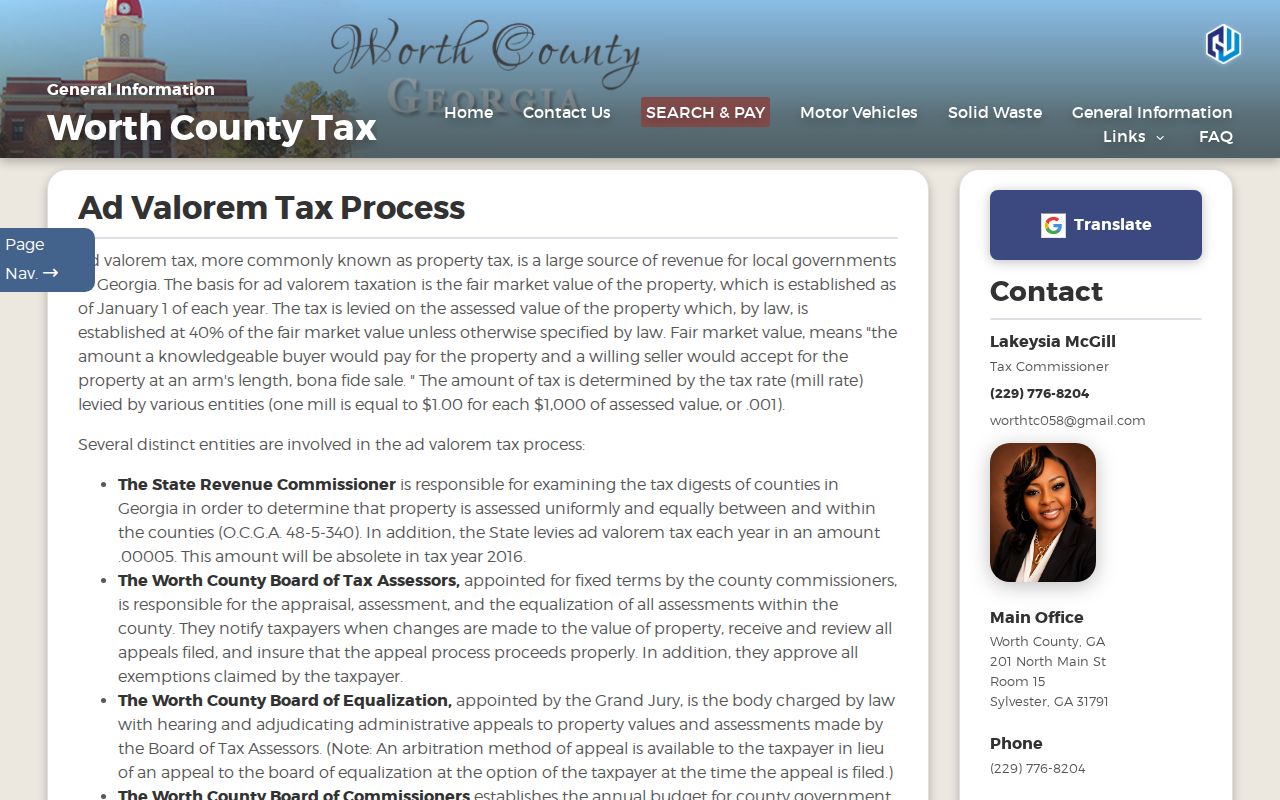
That page supplies the terminology, but the parcel's own bill and digest entry carry the current amounts and dates that matter.
Assessor and Collector Roles
The Worth County Board of Tax Assessors establishes value. Assessment notices, parcel characteristics, fair market value, and valuation challenges all belong to that office. The Tax Commissioner, meanwhile, bills, collects, accounts for, and distributes property tax, and never sets value or millage.
Board of Tax Assessors
201 N Main Street, Sylvester. Call (229) 776-8203 for assessment, parcel-review, or value questions.
Tax Commissioner
Room 15, 201 N Main Street, Sylvester. Call (229) 776-8204, Monday through Friday, 8:00 a.m. to 4:30 p.m.
Suppose the bill and the digest disagree. Write down each source and tax year before calling. Staff can then tell whether the gap comes from an exemption, an appeal, new millage, a payment posting, or a revised digest.
Worth County Assessment Math
Georgia starts with fair market value on January 1. Worth County then applies the state's 40% assessment relationship to that figure. Exemptions come off next. The remaining taxable value gets multiplied by millage, which produces the tax bill.
That sequence explains a common puzzle. Two parcels with nearly identical fair market values can end up with different taxable assessments. Exemption status drives much of the gap. So does the tax district, since millage rates vary across the county.
- Fair market value
- The assessor's estimate of full value as of the valuation date.
- Assessed value
- Forty percent of fair market value under the county's stated Georgia rule.
- Mill
- One dollar of tax for each $1,000 of assessed value.
- Tax FIFA
- A tax execution entered after delinquency; it is not proof that the parcel was sold.
A current calculation needs current inputs. The separate Worth County property value page explains why assessment, taxable value, and sale price should stay distinct.
Find a Worth County Tax Bill
Start at the official Worth qPublic parcel endpoint. Form labels and result columns vary by county, so confirm what the live screen shows rather than assuming a generic layout. A generic vendor view may not match Worth. Once the parcel is identified, follow the Tax Commissioner's official search or payment link and keep the bill year visible.
- Search the parcel by street address, owner name, or the exact parcel number shown in an official notice.
- Record the fair market value, assessed value, exemptions, tax year, and any displayed update date.
- Open the Tax Commissioner's linked bill channel and compare the tax year, district, amount, and status.
- For a missing or unclear entry, call the proper office or ask for an existing electronic record under Georgia's open-records process.
Checks can be mailed to the Tax Commissioner's courthouse office. The local page also lists a drop box in the alley between the courthouse and jail, along with phone and online payment channels. Verify accepted methods and the current amount before paying.
Worth Tax Dates Conflict
Worth County publishes a date quirk worth catching. The general-information page says real-estate taxes are due by November 15, yet the Tax Commissioner FAQ describes two installments, October 15 and November 15, with weekend deadlines shifting to the next business day. Do not merge those statements silently. Check the actual bill and the latest office notice for the year at issue. The FAQ adds that real and personal property statements go out by September 15. Mobile-home statements are mailed by January 30. A bill that never arrives does not erase the obligation.
Note: Preserve the issue date, due date, payment date, and tax year. Do this whenever a Worth County property tax record serves as evidence.
Worth's 2025 Reassessment Shift
A county notice published October 14, 2025 described a state-mandated countywide reassessment. It proposed dropping millage from 12.552 to 9.847, which the notice called the lowest rate since 1998. Digest growth still produced a legally calculated 15.52% tax increase. Those figures belong to that notice alone and are not a permanent rate.
The notice illustrated the shift with a $200,000 fair market value example, showing about $68.27 more for a homestead parcel and $70.02 more for a non-homestead parcel. It was an illustration, not a calculation for every property. Local reporting later tied the revaluation to delayed 2025 bills. Before comparing two records, line up the assessment date, appeal status, final millage, bill issue date, and tax year.
The qPublic landing page also announces a three-year countywide parcel review by GMass. Reviewers may examine ownership changes, permits, returns, fire or demolition, and new construction, and may measure or photograph improvements. That can explain a field visit or changed building data, though it does not mean every parcel card updates at once.
Worth Exemptions and Returns
Worth County's general information covers homestead, Freeport, and other local exemptions. Eligibility hinges on the specific exemption and how it is filed. Once approved, an exemption reduces taxable assessed value. It leaves the recorded deed untouched. It does not force the assessor's fair market value to move. Owners of real property should file a return between January 1 and April 1 after acquiring property or making changes, local guidance says. Returns carry forward after that unless amended. An unreturned value can draw a 10% penalty, the county warns. Before relying on a prior-year record, confirm the current form, eligibility, and deadline with the assessor.
Delinquent Worth Property Tax
Interest on unpaid Worth property tax starts the day after the due date. The county publishes the formula. Penalties can stack on top of it. The Tax Commissioner may then take a tax FIFA. It is filed on the Clerk's General Execution Docket. That filing is a public execution record, nothing more. It is not proof that a tax sale ever closed. Collection can also bring notice charges and title-search costs. Levy steps, posting or photography, and a month of newspaper ads can follow. An ad can run for a sale later withdrawn or changed. Before relying on anything, confirm the FIFA, any cancellation or transfer, and any resulting deed with the Tax Commissioner and the Worth County Clerk of Superior Court.
Request Missing Worth Tax Records
When an online entry for a Worth parcel comes up empty or wrong, ask the assessor or Tax Commissioner directly for what already exists: the parcel card, a digest field, the bill, a payment record, or a notice, all tied to the parcel number and tax year. Georgia's Open Records Act guidance calls for a response within three business days. If an office needs more time, it should still name the records, give timing and a cost estimate, and cite any legal ground for withholding. Ask for an electronic copy when that is practical, and request a fee estimate first. The first quarter-hour of staff time is free under state guidance, but no office has to build a new report or custom parcel analysis. A narrow request for an existing file works best.
Contest a Worth County Assessment
A Worth County assessment appeal can attack the value, the uniformity, or the taxability. It can also challenge an exemption denial. It cannot rest on the Tax Commissioner's arithmetic alone. Read the assessment notice closely for the filing window. Follow the instructions that come with it. Strong support includes comparable sales, photographs, a recent appraisal, repair estimates, maps, and surveys. It also helps to show that the county's parcel facts are simply wrong.
Appeal window. Use the deadline printed on the current assessment notice. The research did not establish one universal calendar date for every Worth County appeal.
The Worth County Board of Equalization page lists the issues and evidence the board weighs. Keep proof of delivery, the notice, and the decision. An open appeal can also explain a mismatch. The value or bill may differ from an earlier record.
Separate factual corrections from value arguments. Wrong acreage, building facts, district, or exemption status needs proof of that fact. A uniformity claim needs dated comparable evidence from the same cycle. Save the parcel card before and after correction. Then compare the revised assessment with the later bill.
Tie the appeal file to one tax year. Worth's 2025 reassessment shows why values can shift mid-story. A notice value, a pending appeal, the final digest, and the issued bill each capture a different stage. Note the date received and the filing date. Also note the grounds selected, the evidence submitted, the hearing notice, and the decision date. If the Board changes the assessment, ask a timing question. When does that result reach the digest and billing record? A paid bill does not erase the need to preserve the decision. Treat an unresolved appeal as anything but a final value.