
Compare Worth County Value Types
For value comparisons, the Worth County Board of Tax Assessors qPublic page is the hub. It publishes the current digest. It also connects to the parcel search, where a parcel number opens the county's appraisal details. The Tax Commissioner's guidance supplies the 40% assessment relationship. Deed and PT-61 records round out the picture with transfer context. Each figure answers a different question, so keep them separate.
| Value | What It Is | Where |
|---|---|---|
| Fair market value | Assessor's January 1 full-value estimate | Published digest |
| Assessed value | Forty percent of fair market value | Published digest |
| Taxable value | Assessed value after eligible exemptions | Assessment and tax records |
| Sale or consideration | Amount reported in transfer context | Deed or PT-61 |
An assessed value is not a forecast of sale price. Exemptions can cut taxable value while fair market value stays put. A deed amount may stem from a family transfer, an estate, or a partial interest. Other terms can make it a shaky market comparison. The official Worth qPublic landing page names the assessor's published-digest role. It also links the parcel search.
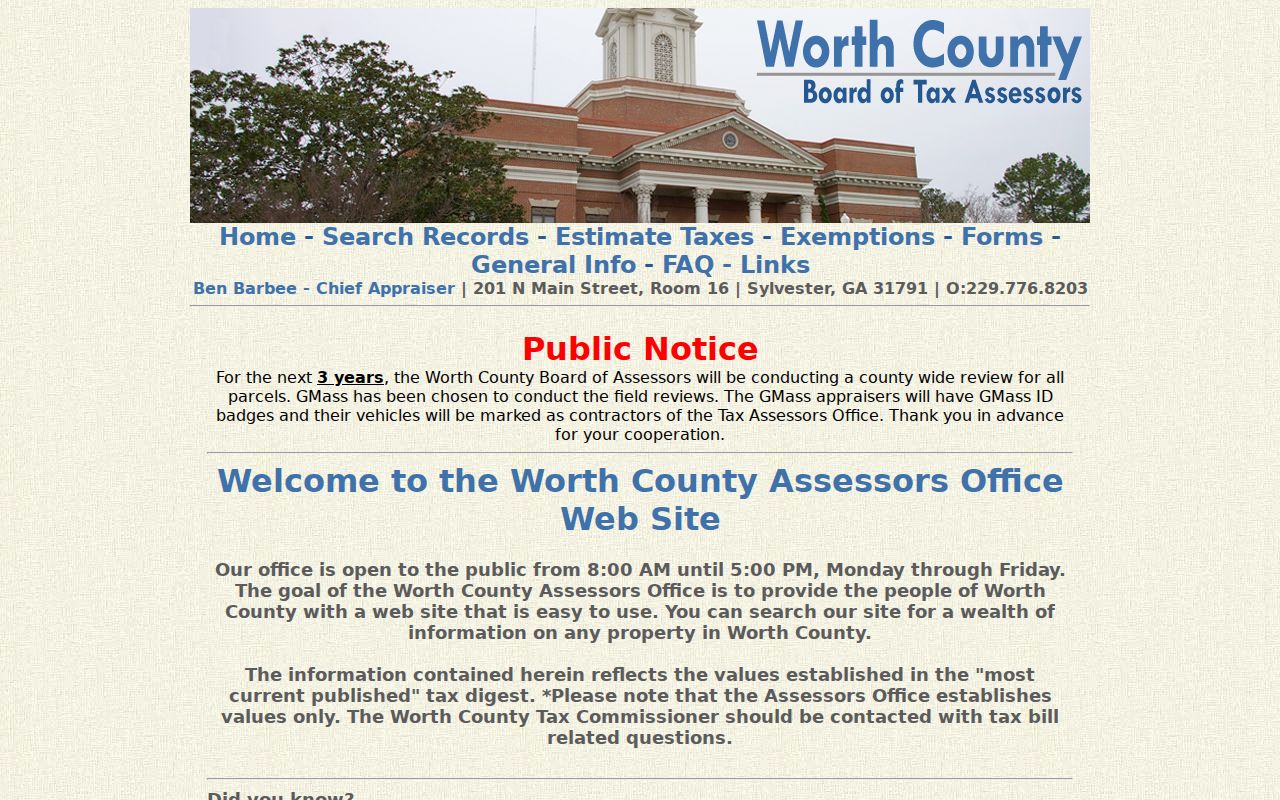
The official qPublic page marks the correct access route. Check the live parcel card for its displayed value year and fields.
Find a Worth County Value
Start with the official Worth qPublic parcel search. Read its live labels as displayed; a result column from another county's interface tells you nothing about Worth County property records.
- Search the address and confirm the parcel identifier and situs.
- Copy the fair market, assessed, and taxable figures actually shown, plus the tax year.
- Check the recorded deed or PT-61 for sale date and transfer context.
- Compare only date-matched records and note any pending appeal or reassessment.
- Assessed value
- The statutory share used before exemptions and millage.
- Fair market value
- The assessor's estimate of full value on the valuation date.
- Assessment ratio
- The relationship between assessed and fair market value, stated locally as 40%.
- Consideration
- The amount or value reported with a conveyance, which may not equal open-market price.
- Reassessment
- A new review of value for the tax digest.
Worth Uses the 40% Relationship
Worth County starts each tax year with a January 1 valuation date. The Tax Commissioner's general information lays out the arithmetic. Assessed value in Worth County equals 40% of fair market value. Any eligible exemption trims the net taxable assessed value before millage ever enters the picture. One mill, in plain terms, is one dollar of tax per $1,000 of assessed value.
Those official labels are worth understanding. The math will not turn an assessed figure into a market appraisal. A millage rate measures tax, not worth.
Sale Price Needs Deed Context
Worth deed records and PT-61 transfer filings can show a consideration or sale figure. GSCCCA offers real-estate and PT-61 search modes. Some tools sit behind an account or fee. Read the buyer, seller, date, instrument type, and property description alongside the amount. A nominal or odd value often signals a non-arm's-length transfer. Confirm the instrument through the Worth County Clerk of Superior Court. Don't treat one number as the parcel's current worth.
Worth Exemptions Change Taxable Value
Homestead, Freeport, and other approved exemptions can shrink taxable assessed value. They do not rewrite the deed, settle ownership, or automatically lower the assessor's fair market estimate. Two nearly identical parcels can end up with very different taxable figures for that reason. Apply each exemption to its stated tax year. The assessor handles eligibility, application timing, and status. The Tax Commissioner answers billing questions.
Reassessment Changed Worth Comparisons
A Worth County notice from October 2025 described a state-mandated countywide reassessment. It proposed dropping millage from 12.552 to 9.847 while digest growth still produced a legally calculated 15.52% increase. Those were notice figures, not fixed assumptions. The notice's $200,000 fair-market increase example projected roughly $68.27 more for homestead property and $70.02 more for non-homestead. That was an illustration only. Local property records also noted delayed bills and outstanding appeals. Date-match every comparison by valuation date, digest year, appeal status, and bill issue date.
Field Reviews Can Shift Details
qPublic has announced a three-year countywide review with GMass field work. Reviewers may look at recent ownership changes, permits, returns, fire or demolition, and construction. They may measure or photograph improvements. Marked vehicles and identification appear in the county notice. A review can explain new building data or a value shift. It does not mean every card updates at once. The county publishes no fixed refresh cadence or typical deed-to-roll lag.
Date-Match Worth Value Evidence
Hang onto the dates. Note the tax year, digest publication date, and assessment date. Track deed execution and recording dates, PT-61 sale date, permit date, appeal status, and source. "Current value" says almost nothing when those events fall in different cycles. When the roll and a transfer disagree, report both with their dates. The Worth County property tax records page covers bills, exemptions, and appeals. Value analysis should stop at what each number means.
Worth Values Need Like Comparisons
Compare parcels from the same assessment cycle. Split land from improvements when those fields appear. Acreage, class, location, building facts, and transfer terms can make a nearby property a poor match. A digest comparison is a clue, not a private appraisal. Recent permits, construction, fire, demolition, parcel division, or an ownership change may trigger field review. See whether the parcel card reflects that event. If a key fact is wrong, preserve the record as viewed and contact the assessor about a correction.
Request a Missing Worth Value
If qPublic comes up short, ask the Board of Tax Assessors for the existing parcel card or digest fields. Give the parcel number and tax year. Georgia open-records guidance normally calls for a response within three business days. Or ask for a statement of timing, cost, and any withholding basis. Request electronic delivery and a cost estimate. An agency need not build a fresh appraisal or custom comparable-sales analysis. The narrow ask is for the property records it already keeps.
Limits of Worth Assessor Value
The digest shows a mass appraisal, not a fresh opinion of what a house would fetch today. Worth County updates these figures on an assessment cycle, so the number can lag behind a recent sale or sit under review. A private appraisal serves a different purpose and carries a different date, so gaps between it and the digest are normal.
Value versus price. Worth's assessed value is used for taxation and is not a forecast sale price. It is not a parcel-specific appraisal.
Missing a field? Ask the assessor for the card or digest entry by parcel number and year. Georgia open-records rules permit electronic requests. An agency will not produce a new appraisal or custom analysis, though. Treat any estimate you receive as a dated opinion. It is not an official Worth County property value.
Comparisons work best when each figure keeps its label. Fair market value ties to the assessor's valuation date and cycle. Assessed value comes from the 40% relationship in Georgia law. Taxable value drops further once exemptions apply. A deed or PT-61 amount belongs to a single transfer. That transfer may not even be an open-market sale.
Check parcel identity before judging two records inconsistent. Match the address, parcel number, acreage, legal description, land and improvement fields, and tax year. A split, combination, or omitted tract can make records look contradictory. They may simply describe different property. A recent sale and the digest can disagree. Confirm deed execution, recording, transfer date, assessment date, and digest publication. Report both figures with their official labels and dates. Avoid crowning one as the "true" value.
Document a Worth Value Finding
Start a value note with the exact parcel identifier and situs. Then record the assessor's field labels, every displayed value, and the tax year. Note the valuation date if shown. Include digest status and access date too. Land and improvements deserve separate entries. Reporting only the total loses detail. List approved exemptions apart from fair market and assessed value. Exemptions change taxable value but not the recorded conveyance beneath it.
Transfer context calls for more. Add the deed parties, instrument type, execution and recording dates, and book/page or instrument number. Record whatever PT-61 information exists. Instrument type matters here. A security deed, estate deed, quitclaim, related-party transfer, or partial-interest conveyance may offer no useful open-market comparison. The recorded amount only means something with its instrument context attached.
Finish with a dated conclusion. Name assessor fair market value for a specific digest year. Name assessed value under Worth's 40% relationship. Or name taxable value after listed exemptions. Consideration reported for one identified transfer also works. That precision keeps a Worth County property value from being mistaken for a current appraisal. It is not a guaranteed sale price. It is not a final tax bill.